
Take a walk through any of the major commercial districts in the Philippines – be it a busy mall in Metro Manila, a transport hub in Cebu, or a highway filled with provincial traffic – and you’ll notice something right away: out of home (OOH) advertising is ubiquitous.
It’s hard to argue with the ubiquity of OOH in the Philippines, as brands continue to pour money into the space as an integral part of their media mix.
However, the majority of these advertisers still can’t answer the seemingly simple question: Who saw our billboard?
And that’s the catch. The Philippines boasts one of the most active and growing OOH markets in Southeast Asia, yet measurement remains underutilized, with the majority of campaigns still using vehicle traffic counts as a surrogate for measuring audiences, as opposed to actual people.
What does real audience measurement mean for the modern advertiser, and how does this impact the way you think about OOH media in the Philippines?
What Is Audience Measurement? (And What It Is Not)
At its heart, audience measurement is about understanding people—not just the number of people, but the number of people who were actually exposed.
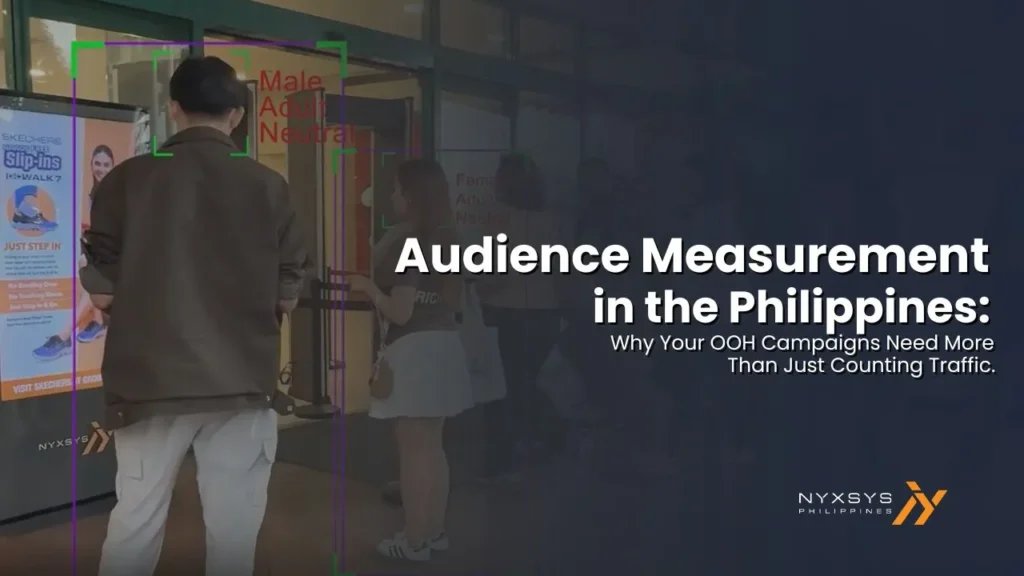
Audience measurement is the process of collecting data on the people who were exposed to the display of an advertisement. It measures the verified number of human impressions, including the time of day, the amount of time they were exposed, the number of times they were exposed, and demographic signals. It’s the answer to the basic question: How many people saw the ad, not just how many people walked by the ad?
To understand its value, it helps to contrast it with what most Philippine advertisers still rely on today:
- Vehicle traffic counts — Measures cars passing a point. It does not confirm that any person saw the display. A moving vehicle is not the same as an engaged viewer.
- Demographic Exposure Count (DEC) — A modelled estimate derived from survey data. It is not real-time and is often months out of date, making it less useful for active campaign decisions.
- Impression estimates — Calculated projections based on assumptions. While useful for planning benchmarks, they are not verified observations of human exposure.
All of these approaches have their own uses in traditional media planning. However, all of them share a common weakness: they are based on models and assumptions rather than actual behavior.
Audience measurement will give you actual data. The rest will give you a model of what probably happened.
Why Traffic Counts Alone Are Not Enough for OOH Campaigns
For many advertisers, traffic data is a natural place to begin. A high traffic source means high visibility. Of course, this is not as simple in practice as it is in theory, and it affects campaign performance in important ways.
Traffic counts measure proximity, not attention
A jeepney passing by a billboard along EDSA may have dozens of passengers. However, how many of those passengers actually viewed the ad?
Traffic counts only show that something or someone passed a point. However, it does not show if the ad was within the line of sight, if it was visible long enough to be seen, or if it actually registered with the audience.
Audience measurement helps bridge this gap to show how long an ad was visible to the audience. It also helps differentiate between a mere opportunity to see an ad and a real impression of it.
Aggregate numbers hide campaign-critical patterns
However, high traffic figures should be viewed with caution as they may not be entirely accurate.
For instance, a billboard may have an audience measurement figure of 80,000 vehicle passes per week. This may be seen as extremely profitable for advertisers. Nevertheless, if most of this traffic occurs between midnight and early morning hours, the number of people who may be interested in certain brands may be much fewer.
Audience measurement helps to dissect this information in a way that is useful for making decisions. It indicates the time people are present and the time they are most likely to be present.
You cannot optimise what you cannot measure
Perhaps the most significant limitation of traffic-based planning is the lack of a feedback loop.
Without real audience data, advertisers cannot confidently answer key questions:
-
- Is this location reaching the right audience?
- Is the creative effective in capturing attention?
- Should this placement be renewed, replaced, or repositioned?
Consequently, OOH advertising campaigns may become static investments with no room for improvement or adaptation.
Audience measurement completely flips the script. It turns OOH advertising from a static spend into a measurable and optimizable medium where decisions are based on performance rather than assumptions.
What Real Audience Measurement Captures
Effective people and traffic measurement platforms capture a range of data points that provide a far more complete picture of campaign performance:
-
- Verified people count — The actual number of individuals exposed to the display, not inferred from vehicle volume
- Dwell time — The duration people remain within viewing range, indicating the likelihood of message absorption
- Peak exposure windows — Specific hours and days when the highest-quality impressions occur
- Repeat exposure rate — How frequently the same individuals encounter the same ad over time
- Location context — The environment in which exposure happens, such as transit stops, mall entrances, or highways
- Content performance — Insights into which creative executions hold attention longer and perform better
Together, these data points provide a multi-dimensional view of OOH performance—one that goes far beyond simple counts.
The State of Audience Measurement in Philippine OOH Advertising
The OOH market in the Philippines is growing rapidly. The growth is not just in terms of size but also in terms of complexity. Metro Manila is still the center of the OOH industry; however, the growth in the other major cities of Cebu and Davao, along with the major provincial roads, is increasing rapidly.
However, the growth in the OOH industry has not been accompanied by an equivalent growth in the way the industry is measured.
The majority of the advertisers are still using estimated reach as the way to plan and buy OOH media. Although this has been the case in the past, this creates inefficiencies in the market as the amount of media spend continues to grow.
At the same time, the emergence of digital OOH media is also changing the landscape of what is possible. LED billboards, digital poster boxes, and programmatic displays are more naturally compatible with audience measurement technologies than static media.
Globally, countries such as Singapore, Australia, and the United Kingdom have already moved beyond static media and are currently enjoying the benefits of verified audience data. The same is now possible for the Philippines.
For forward-thinking brands, this represents an opportunity for competitive advantage. Those who are first to adopt audience measurement will be able to optimize their campaigns and derive more value out of OOH advertising.
Why Choose Nyxsys for Audience Measurement in the Philippines
Choosing a measurement partner who can deliver verified data within an active Philippine media network is not common. That is exactly what Nyxsys is built to do.
Calton Datx: Built for Philippine OOH Environments
Nyxsys’ proprietary system has the capability to collect people and traffic data in real-time. It has been built with the unique visual density and lighting conditions of the advertising landscape in the Philippines in mind.
People Measurement, Not Just Traffic Counting
Nyxsys goes beyond vehicle-based metrics. The platform captures verified human impressions, giving advertisers access to meaningful CPM data grounded in real exposure.
Integrated Across the Network
Audience measurement is not an add-on. It is embedded directly into the Nyxsys media network, eliminating delays, integration issues, and fragmented reporting.
Actionable Reporting
Data is delivered in clear, campaign-ready formats. Advertisers can evaluate performance by location, time window, and creative execution—and use these insights to inform real decisions.
Local Team, Philippine Market Knowledge
Nyxsys operates within the Philippines, with a team that understands local media dynamics. This ensures faster support, more relevant insights, and reporting aligned with how campaigns are actually planned and executed.
OOH Advertising Industry in the Philippines: A New Phase of Maturity
With increasing investments in media, there is a parallel increase in the need to account for performance. While brands continue to bet on their investments using only traffic estimates, those who start using audience measurement will not only have the power to optimize their campaigns, but do so in real-time, with confidence. This is not a future scenario, but one that is already unfolding.
This is where Nyxsys can help you. Whether you’re looking to launch a single billboard ad campaign or manage multiple locations across the country, you already have the tools to improve your audience reach.
Book a strategy session with Nyxsys.
See your audience data in action.